

How Outsourcing Helps Small Businesses Cut Costs and Scale


Outsourcing lets small businesses cut operating costs, access specialized skills, and scale faster without hiring full-time staff. According to the U.S. Chamber of Commerce, 83% of small businesses planned to continue or increase their outsourcing spend, and 59% of businesses cite cost reduction and core-task focus as their primary reasons for doing it. The SBA identifies accounting, marketing, HR, IT, and customer service as the functions most commonly and successfully delegated.
Here is what you can expect when you start outsourcing the right way:
Lower overhead. Fixed costs like salaries, benefits, and equipment convert to predictable vendor fees.
Faster execution. Specialists handle tasks in hours that would take a generalist days.
More owner time. You reclaim hours to focus on revenue-generating work.
On-demand capacity. Scale up for a busy season, scale back when demand drops, without the HR burden.
Reduced errors. Dedicated professionals in bookkeeping or compliance catch mistakes before they become penalties.
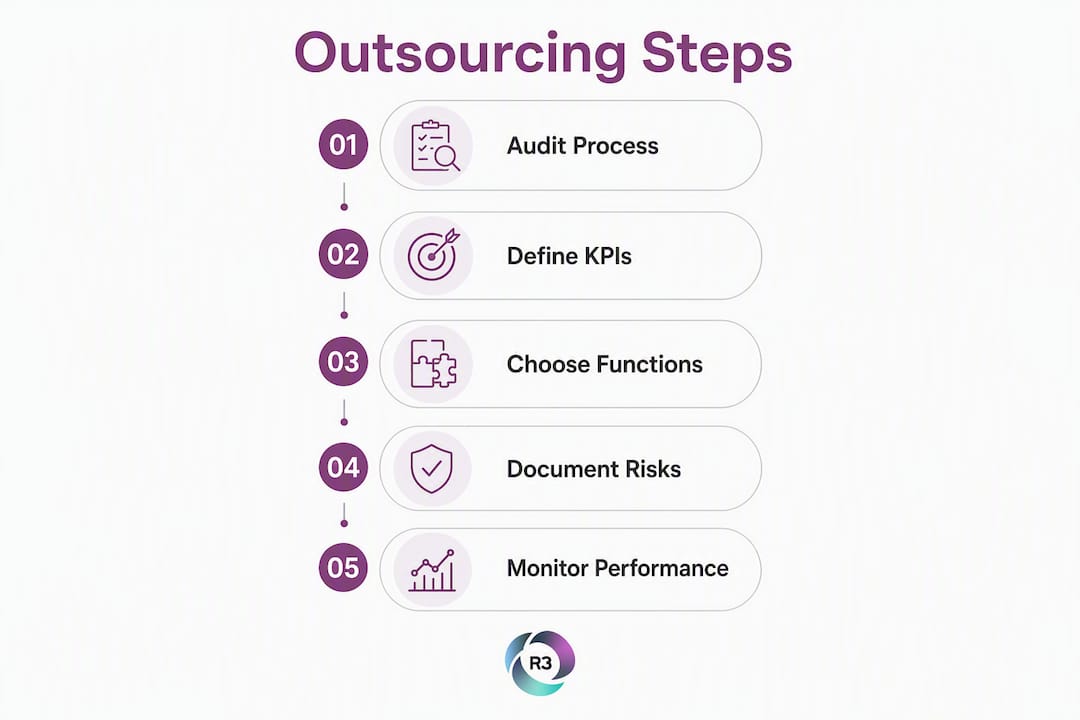
Your next action: audit one repetitive process you handle personally this week and ask whether a trained specialist could do it better, faster, and cheaper.
Table of Contents
How outsourcing delivers real, measurable benefits for small businesses
What are the real risks of outsourcing, and how do you avoid them?
How to choose the right outsourcing partner: a practical checklist
What does outsourcing actually cost, and when will you see ROI?
Real-world outcomes: what dedicated remote staff actually deliver
Why dedicated remote staff outperform task-based freelancers for most small businesses
R3source gives you a dedicated remote team, not just a task list
How outsourcing delivers real, measurable benefits for small businesses
The phrase “save money” undersells what outsourcing actually does. The deeper shift is structural: you stop paying for capacity you do not use.
When you hire a full-time employee, you pay their salary whether the work is there or not. You also absorb payroll taxes, health benefits, equipment, onboarding, and management time. Strategic outsourcing converts those fixed overheads into variable costs, so your spend tracks your actual workload. A customer support agent who costs roughly $55,000 fully burdened in-house can often be replaced by a vendor invoice in the $18,000–$24,000 annual range for equivalent coverage.
Beyond cost, the benefits stack up quickly:
Access to specialized skills. Outsourcing connects you to expertise that would take months and significant budget to build in-house. A fractional CFO, a certified bookkeeper, or a trained customer service team is available from day one.
Faster execution. A specialist who does one thing all day executes faster and with fewer errors than a generalist juggling five roles.
Improved customer service. Dedicated support staff respond faster, maintain consistent tone, and handle volume spikes without burning out.
Seasonal elasticity. Outsourcing scales with demand, so an e-commerce business can staff up for Q4 and pull back in January without layoffs or severance.
Competitive access to technology. Managed IT providers and marketing agencies bring tools and platforms your business could not justify buying independently.
Pro Tip: Before you hand off any process, document it. Write a simple standard operating procedure (SOP) that covers the steps, decision rules, and expected outputs. Outsourcing a broken or undocumented process transfers the chaos to your vendor and erodes ROI from day one.
Which business functions should you outsource first?
The SBA recommends starting with functions that are rules-based, repetitive, and do not require deep institutional knowledge. Those are the easiest to hand off, the fastest to show results, and the lowest risk if something goes wrong during onboarding.
Here is a prioritized breakdown of the most common functions, why each fits outsourcing, and the metrics to track:
Accounting and bookkeeping. Rules-based, time-sensitive, and high-penalty if done wrong. Outsource to a certified bookkeeper or accounting firm and track error rate, on-time close rate, and late-filing incidents. A retail owner who outsources monthly reconciliation typically eliminates end-of-quarter scrambles and reduces tax-prep fees. For businesses that want expert accounting oversight, working with a dedicated financial advisory firm can add a layer of strategic guidance beyond basic bookkeeping.
Payroll and HR administration. Compliance-heavy and time-consuming. Track payroll accuracy rate and compliance incident rate. A 10-person team spending four hours per pay cycle on manual payroll processing can reclaim that time immediately.
Customer service. High volume, measurable, and directly tied to retention. Track CSAT score, first response time, and ticket resolution rate. A dedicated support team handles overflow without the cost of a full in-house department.
IT and helpdesk. Managed service providers reduce security risk, provide strategic IT planning, and free your team from troubleshooting. Track system uptime, mean time to resolution, and security incident count.
Marketing support. Content creation, social media management, and paid ad management are all strong candidates. Track leads generated, cost per lead, and content output volume.
Administrative tasks and virtual assistant work. Email management, scheduling, data entry, CRM updates, and appointment setting. Track hours reclaimed per week and task completion rate. This is often the highest-ROI first outsource for solo operators. You can explore what tasks are worth delegating before committing to a role.
Fulfillment and logistics. For e-commerce sellers, outsourcing FBA prep and order fulfillment removes warehouse overhead and reduces shipping errors. Track order accuracy rate and fulfillment cycle time. Outsourcing FBA prep is a well-documented path to faster scaling for Amazon sellers.
Web development and design. Project-based work with clear deliverables. Track on-time delivery, revision cycles, and post-launch bug rate.
Specialized services. Medical billing, legal support, and financial analysis require certified expertise. Outsourcing these reduces compliance risk and often costs less than a part-time specialist hire.
Pilot rule of thumb: Start with functions that are repetitive, rules-based, and low-confidentiality. Accounting, admin, and customer service check all three boxes and are where most small businesses see the fastest return.

What are the real risks of outsourcing, and how do you avoid them?
Outsourcing fails most often not because the vendor is bad, but because the business was not ready to hand off the work. Here are the common failure modes and what to do about each.

Communication breakdowns happen when expectations live in someone’s head instead of a written brief. The fix: document your SOPs before onboarding and hold a weekly sync for the first 90 days.
Quality inconsistency usually traces back to missing KPIs. If you never defined what “good” looks like, you cannot hold anyone accountable for falling short. Set two to three measurable KPIs per function before the contract is signed.
Cultural and time-zone mismatches slow down collaboration. Vet for English proficiency, overlap hours, and communication style during the interview stage, not after.
IP and data security lapses are the highest-stakes risk. Require signed NDAs, role-based access controls, and a clear data handling policy. Failing to standardize processes and set measurable SLAs before handoff is where most outsourcing ROI evaporates.
Vendor churn disrupts continuity. Ask about staff turnover rates and retention incentives during vetting. A provider with high turnover will cost you retraining time repeatedly.
Mitigation checklist for the selection and contract stage:
Define SLAs and KPIs in writing before signing.
Require a shadowing or pilot phase (two weeks minimum) before full cutover.
Implement role-based access controls and revoke credentials immediately on offboarding.
Include a data handling and confidentiality clause in every contract.
Ask for references from clients in your industry.
Negotiate a 30-day exit clause so you are not locked in if performance falls short.
Red flags to walk away from: no documented SLAs, opaque or shifting pricing, no client references, inability to explain their staff turnover rate, and no trial period option.
Pro Tip: Ask every vendor candidate: “What happens when a team member assigned to my account leaves?” Their answer tells you everything about their retention model and how much disruption you will absorb.
How to choose the right outsourcing partner: a practical checklist
Picking the wrong partner costs more than not outsourcing at all. Use this framework to vet, hire, and onboard with confidence. You can also reference the business scaling outsourcing checklist for a fuller pre-hire audit.
Selection checklist
Verified skills and experience in your specific function (ask for work samples or a skills test)
Cultural fit and English proficiency appropriate for your customer-facing or internal needs
Documented SOPs and training materials for their team
Clear security and compliance policies (HIPAA, SOC 2, or equivalent where applicable)
Client references from businesses of similar size and industry
Transparent pricing with no hidden fees
Option for a trial period or pilot engagement before a long-term commitment
Staff retention data and a clear policy for replacing assigned team members
Questions to ask every vendor
What KPIs do you track for this role, and how do you report them?
What is your staff turnover rate for this function?
How do you handle training when a new team member is assigned to my account?
What is your escalation process when something goes wrong?
How do you protect client data, and what access controls are in place?
Can you share a sample SOP or workflow document for this role?
What does your onboarding process look like for the first 30 days?
What are the contract exit terms if performance does not meet agreed KPIs?
Pricing models explained
Model | Best for | What to watch |
Hourly | Variable, project-based work | Scope creep; always cap hours |
Fixed monthly (dedicated staff) | Ongoing roles needing continuity | Confirm what “dedicated” means |
Per-project | One-time deliverables (web, design) | Revision limits and milestone payments |
Outcome-based | Lead gen, sales support | Define the metric precisely upfront |
For ongoing operational roles like admin, customer service, or bookkeeping, a fixed monthly dedicated-staff model gives you the most predictable cost and the best continuity.
Onboarding timeline: 30/60/90-day pilot
Days 1–30 (Shadowing phase). The outsourced team member observes your current process, records their work against your SOPs, and flags gaps. No full cutover yet. This phase surfaces misunderstandings before they become errors.
Days 31–60 (Supervised execution). The team member takes ownership of tasks with daily or weekly check-ins. You review outputs and refine SOPs based on what the shadowing phase revealed.
Days 61–90 (Independent operation). Full handoff with agreed KPIs in place. Review performance data at the 90-day mark to decide whether to scale, adjust, or exit.
What does outsourcing actually cost, and when will you see ROI?
Costs vary by function, skill level, and whether you hire domestically or offshore. The table below shows typical monthly ranges for common outsourced roles using a dedicated-staff model.
Typical monthly cost ranges by role
Role | Offshore (dedicated) | Domestic / agency |
Bookkeeper | — | $18,000–$24,000 |
IT helpdesk / tech support | — | $18,000–$24,000 |
These ranges reflect fully managed, dedicated-staff arrangements. Freelance platforms will show lower hourly rates but add management overhead and continuity risk.
When comparing costs, measure Total Cost of Engagement (TCE), not just the vendor invoice. TCE includes employer payroll taxes, benefits, equipment, HR time, and training costs for an in-house hire. That full-burden comparison is where outsourcing’s financial case becomes undeniable.
Onboarding timeline and milestones
Phase | Days | Key activities | Expected milestone |
Audit and prep | — | Document SOPs, define KPIs, select vendor | Signed contract, SOPs ready |
Shadowing | 15–30 | Vendor observes, records, flags gaps | Process gaps identified |
Supervised execution | 31–60 | Vendor takes ownership, daily check-ins | Error rate below target |
Independent operation | 61–90 | Full handoff, weekly KPI review | ROI baseline established |
Simple ROI formula
(Hours reclaimed per month × your effective hourly rate) − monthly vendor cost = net monthly benefit
Example: You reclaim 40 hours per month by outsourcing admin tasks. Your effective hourly rate as an owner is $75. That is $3,000 in recovered productive time. If the vendor costs $1,200 per month, your net benefit is $1,800 per month, or $21,600 per year, before accounting for the quality improvement and error reduction.
Variables that shift costs: offshore vs. domestic location, part-time vs. full-time dedicated staff, skill specialization level, and whether the provider handles management and QA or passes that back to you.
Real-world outcomes: what dedicated remote staff actually deliver
The clearest way to understand the impact of outsourcing on small business growth is to look at what changes when a dedicated remote professional joins a team, not as a freelancer picking up tasks, but as an integrated team member with defined KPIs and accountability.
Consider a service-based business owner spending 15 hours per week on appointment scheduling, follow-up emails, and CRM updates. Those are not revenue-generating hours. A dedicated virtual assistant, onboarded through a structured 90-day pilot, can absorb all three functions within the first month. By day 60, the owner is typically back to client-facing work full time, and the VA is handling 200+ CRM records per week with a task completion rate above 95%.
For an e-commerce business managing customer inquiries across email and chat, a dedicated customer service representative reduces first response time from hours to minutes and lifts CSAT scores measurably within 60 days. The owner stops being the de facto support team.
The R3source model follows an audit-to-pilot-to-scale flow: identify the function, define the KPIs, run the 90-day pilot, then expand the scope based on measured results. That structure removes the guesswork and gives you a clear decision point at each stage.
Suggested KPIs by function:
Virtual assistant / admin: Task completion rate, hours saved per week, SLA adherence
Customer service: CSAT score, first response time, ticket resolution rate, escalation rate
Bookkeeping: Error rate, on-time close rate, reconciliation turnaround time
Marketing support: Leads generated, cost per lead, content pieces delivered per month
Lead generation: Qualified leads per week, conversion rate from outreach, CRM update accuracy
Pro Tip: Set your KPI targets before the pilot starts, not after. Defining success criteria mid-engagement lets underperformance slide and makes it harder to hold anyone accountable at the 90-day review.
Key Takeaways
Outsourcing works best when you treat it as a structured business decision: audit one process, define your KPIs, run a 90-day pilot, and scale what delivers measurable results.
Point | Details |
Start with rules-based functions | Accounting, admin, and customer service are the lowest-risk, highest-ROI first outsources. |
Measure Total Cost of Engagement | Compare vendor cost against the full burden of an in-house hire, including taxes, benefits, and equipment. |
Run a 90-day pilot | Use a shadowing phase (days 1–30), supervised execution (days 31–60), and independent operation (days 61–90) before scaling. |
Define KPIs before signing | Set two to three measurable success metrics per function in the contract; never start without them. |
R3source for dedicated remote staff | R3source places trained, long-term virtual assistants and remote professionals from the Philippines into U.S. small businesses, with managed onboarding and SLA accountability built in. |
Why dedicated remote staff outperform task-based freelancers for most small businesses
The outsourcing market has fractured into two very different models, and most small business owners do not realize they are choosing between them until something goes wrong.
Task-based freelancers are excellent for one-off projects: a logo, a website audit, a batch of blog posts. They are not built for continuity. Every time a freelancer churns, you absorb retraining time, context loss, and a dip in output quality. For functions that require ongoing domain knowledge, like knowing your customers, your CRM, your tone of voice, that churn cost compounds fast.
Dedicated remote staff operate differently. They learn your business, build institutional knowledge, and show up accountable to the same KPIs week after week. That model is where most outsourcing ROI is actually unlocked, because consistency compounds in ways that task-based work cannot.
There are situations where freelancers or in-house hires are the right call. If you need a one-time deliverable with a clear endpoint, a freelancer is faster and cheaper. If a function requires physical presence or real-time decision-making authority, in-house is the answer. But for the operational backbone of a growing small business, dedicated remote staff deliver something freelancers rarely can: reliability you can build on.
The hybrid model, onshore oversight with offshore execution, is where the industry is heading. Businesses that figure this out early build a structural cost advantage their competitors cannot easily replicate.
R3source gives you a dedicated remote team, not just a task list
Most outsourcing guides stop at “find a freelancer.” R3source takes a different approach entirely. Instead of matching you with a rotating pool of contractors, R3source places dedicated virtual assistants and remote professionals from the Philippines directly into your operations, trained to your SOPs, accountable to your KPIs, and managed for long-term retention.

The services map directly to the functions covered in this guide: administrative support, customer service, lead generation, CRM management, appointment setting, marketing support, and bookkeeping. Every placement includes a structured onboarding process, defined SLAs, and a dedicated account manager who handles performance oversight so you do not have to.
For U.S. small business owners who are ready to stop doing everything themselves, the next step is straightforward. Book an introductory consultation with R3source to identify which function to pilot first, get a cost estimate, and start your 90-day onboarding plan. Or explore the full offshore virtual assistant services page to see exactly what a dedicated remote professional can handle for your business.
Authoritative sources and further reading
U.S. Small Business Administration: 10 Small Business Functions That Can Be Easily Outsourced — SBA guidance on common outsourceable functions and efficiency principles.
U.S. Chamber of Commerce: An Entrepreneur’s Guide to Outsourcing — Adoption data, strategic framing, and benefit categories for small business owners.
Recommended
Comments