

Convert Roles After Three Hires: Executive Remote Staffing Playbook


Remote and hybrid staffing have moved past the experimental phase and into permanent operating strategy. The businesses winning in 2026 aren’t debating whether to staff remotely. They’re redesigning roles, onboarding, and management systems so remote hires perform like long-term team members instead of rotating contractors. If you lead a growing company, the immediate move is simple: define outputs clearly, invest in retention infrastructure, and pilot converting your recurring roles into dedicated staff wherever continuity actually matters.
Transitioning to remote-first requires redesigning roles around outcomes and establishing overlap policies across multiple time zones.
Access to global talent pools now demands asynchronous communication tools and clear handoff protocols to maintain productivity.
Building management rhythms such as regular one-on-ones and tracking retention at 90 and 180 days is crucial for remote team success.
Repeated onboarding costs for freelancers often surpass the expense of hiring dedicated remote staff, especially for ongoing, mission-critical roles.
Effective remote staffing depends on deliberate cultural systems, documented values, and inclusive communication practices to prevent cultural drift.
Table of Contents
The Future of Remote Staffing: Trends Reshaping How You Hire
Three shifts are rewriting the playbook for remote staffing, and each one demands a different response from you as an owner or HR leader.
Hybrid and remote-first are not the same strategy. Hybrid keeps a physical anchor and staggers in-office days, which works when a role needs recurring face time (client-facing sales, some clinical operations). Remote-first drops the anchor entirely and designs every process, from onboarding to performance review, around asynchronous work. Confusing the two is where most staffing plans break. A Penn LPS Online analysis frames this correctly: remote work is a transformation, not a location swap, and it requires leadership to develop different skills than managing an in-office team.
Access to global talent pools is now table stakes, not a novelty. Businesses that once hired only within a 30-mile radius now recruit administrative, customer service, and marketing support staff across time zones. That access comes with a coordination tax: overlap windows, async documentation, and clear handoff protocols become mandatory rather than optional. Statista survey data shows a strong and consistent worker preference for remote and hybrid structures globally, which means the talent pool skews toward candidates who expect this flexibility. If your staffing model doesn’t offer it, you’re recruiting from a shrinking pool.
AI has compressed the sourcing and screening timeline. Recruiter copilots now draft outreach, rank resumes against skills graphs, and schedule interviews without a human touching a calendar. Time-to-first-interview has dropped meaningfully wherever these tools are used well, according to industry guidance on AI-enabled remote staffing. The catch: AI accelerates the funnel, but it doesn’t own the relationship once someone is hired.
Here’s how to separate what needs your attention now from what can wait:
Act now (2025 to 2026): Redesign role descriptions around observable outputs, not hours logged. Build overlap-window policies for any team spanning more than two time zones.
Act now: Introduce AI-assisted screening for high-volume roles like customer service and administrative support, where skills are easier to standardize.
Plan for later (2027 and beyond): Expect regulatory frameworks around cross-border AI hiring tools to tighten. Build vendor contracts that assume audit requirements will expand.
Plan for later: Anticipate that fully distributed org charts will need dedicated culture-building roles. Most companies still treat this as an afterthought.
The businesses that win the next three years won’t be the ones with the most remote hires. They’ll be the ones whose management systems were built for distributed work from the start, instead of retrofitted after turnover spiked.
Benefits of Virtual Staffing vs. the Hidden Operational Costs
Remote staffing gives you real advantages, but every one of them comes with an operational shadow you need to plan for before you scale.
The upside is well documented. You gain access to a talent pool that isn’t bounded by commute distance, which matters enormously for specialized or industry-specific roles like medical billing or legal support staff. Cost flexibility improves because you’re not carrying the overhead of physical office space per new hire. And candidate preference now favors you: Statista’s data confirms most workers actively prefer remote or hybrid arrangements over full-time in-office roles, which means remote-friendly employers see a wider and often more engaged applicant pool.
By the Numbers: A University of Birmingham and LSE study found that a majority of businesses that discontinued remote working reported negative productivity effects, a notably higher share than among firms that kept it. Among the businesses still managing remote teams, team cohesion and collaboration were the most commonly named management challenges.
That second figure is the one leaders underestimate. The challenges aren’t really about technology or time zones. They’re about what disappears when people stop sharing a physical space:
Loss of ambient learning. New hires used to absorb context by overhearing conversations. Remote teams lose that entirely unless you build explicit knowledge-sharing rituals.
Increased documentation time. Every process that lived in someone’s head now has to be written down, which slows initial rollout even as it pays off later.
Onboarding complexity. Without hallway introductions, new remote hires take longer to understand who does what and why.
Hidden management time. Checking in asynchronously often takes more manager hours per employee than a five-minute desk visit would.
The early-warning signs are measurable if you track them. Watch for rising time-to-resolution on cross-team requests, an uptick in duplicated work from unclear ownership, and manager calendars that fill with one-on-ones instead of strategic planning. PNAS research confirms hybrid and remote arrangements can improve retention without hurting performance, but only when implementation is deliberate. Outcomes vary sharply based on whether management systems were actually built for distributed work.
Your Operational Playbook for Remote Staffing Success
Getting remote staffing right isn’t about finding better candidates. It’s about building the systems that let good candidates succeed once they’re hired.
1. Design roles around observable outcomes. Write acceptance criteria for every recurring task the way you’d write a spec for a contractor. “Respond to customer inquiries” is not a role description. “Respond to all inbound support tickets within four business hours, with a resolution rate above 90%” is something you can actually manage and measure.
2. Build structured onboarding with real overlap. Assign a mentor, not just a manual. Every asynchronous team needs deliberate overlap windows in the first 30 days, even if the long-term schedule is fully async. This is where most companies cut corners, and it’s the single biggest predictor of early attrition.
3. Create manager rhythms that replace proximity. Weekly one-on-ones, documented career paths, and embedded supervision aren’t nice extras. They’re the substitute for the hallway check-ins that used to happen automatically. Binghamton University’s research on remote work best practices points directly at leadership and teamwork gaps as the core managerial challenge in virtual settings, not tooling or connectivity.
4. Measure retention at 90 and 180 days. These two checkpoints tell you almost everything. A new hire who’s still engaged at 90 days but gone by 180 usually signals a career-pathing problem, not a fit problem.
5. Get your systems foundation right. A functioning HRIS, clean payroll processes, explicit time-zone planning, and a basic compliance checklist for U.S.-facing operations aren’t optional infrastructure. They’re the difference between a staffing model that scales and one that quietly falls apart at 15 employees.
6. Know your scale triggers. When a role has been filled by three different freelancers in 18 months, that’s your signal to convert it to dedicated staff. Repeated onboarding costs more than most owners realize, and it drains institutional knowledge every time someone leaves.

Pro Tip: Run a small pilot before converting your whole team. Pick one recurring, business-critical role, hire a dedicated remote professional for it, and measure the 90-day retention and output against what a freelancer or task-based hire delivered. That single data point will tell you more than any staffing theory.
For a deeper walkthrough of building these systems from scratch, our guide on remote staffing solutions for business owners covers the full operational sequence. And if onboarding is where you’re losing people, our virtual assistant integration best practices walks through the exact checklist that reduces early churn.
Dedicated Teams, Freelancers, or Offshore Contractors: Which Fits Your Job?
Choosing a staffing model comes down to one question: how much continuity does this specific role actually need?
Freelancers work well for project-based tasks with a clear start and end, such as a website redesign or a one-time marketing campaign. The management burden is low because the scope is fixed, but you get zero institutional knowledge retention once the project closes.
Dedicated remote professionals fit ongoing, business-critical operations, things like customer service, CRM management, appointment setting, or bookkeeping that run every week without a defined end date. Industry comparisons consistently find that dedicated teams outperform freelancers on continuity and retention for exactly this kind of ongoing work, particularly when management bandwidth is already stretched.
Early-stage validation work (testing a new offer, exploring a new market) often justifies a short-term freelancer or a small task-based engagement until you know the role is real.
The hidden costs sneak up on almost every owner who skips this analysis. Repeated onboarding for a revolving freelancer roster adds up fast. Turnover replacement cost, when you factor in lost productivity and management hours, often exceeds what people budget for. And the management time required to supervise five different freelancers frequently costs more than overseeing two dedicated staff members who already know your systems.
Run through this checklist before you commit to a model:
Does this role repeat weekly with no end date in sight?
Would losing institutional knowledge from this role hurt you?
Do you have management bandwidth to onboard a new person every few months?
Is the cost of turnover higher than the cost of a longer-term commitment?
Does this role require deep familiarity with your CRM, customers, or internal processes?
Are you optimizing for the lowest hourly rate, or the lowest total cost over 12 months?
Our offshore hiring guide breaks down the step-by-step process for moving a role from contractor to dedicated staff without disrupting current operations.
AI and Staffing Tech: What Actually Helps You Hire Better
AI tools speed up sourcing and screening, but they cannot own retention. That distinction is where a lot of buyers get misled by vendor marketing.
What’s genuinely useful right now includes recruiter copilots that draft outreach and rank candidates, transcription and summarization tools that cut interview review time, and applicant tracking systems built around skills graphs rather than keyword matching. Used well, these tools compress your time-to-first-interview significantly, based on current industry guidance on AI-enabled remote staffing.
Before adopting any tool, build these guardrails into your procurement process:
Require a bias audit from the vendor before rolling out any AI screening tool at scale.
Set retention KPIs as a contract term, not just placement speed.
Keep a human in the loop on every final hiring decision, no exceptions.
Track vendor impact using two numbers: time-to-first-interview and placement-to-90-day retention.
If a vendor can’t tell you their placement-to-90-day retention rate, that’s a red flag worth taking seriously.
How Remote Staffing Shapes Company Culture Over Time
The cultural risk of remote staffing isn’t isolation. It’s drift, the slow erosion of shared identity when people never occupy the same physical or even the same synchronous space.
Companies that get this right treat culture as a designed system rather than an emergent byproduct of shared office snacks and hallway chatter. That means documenting values in ways people actually reference, building recognition rituals that work asynchronously, and giving remote staff visible paths into leadership conversations, not just task assignments. Companies that skip this step tend to end up with two cultures: an engaged core team and a disconnected periphery of remote hires who never feel like they belong to something larger.
Employee engagement in distributed teams also hinges on transparency. When decisions happen in a Slack thread instead of a hallway conversation, remote staff either see the full context or they don’t. Leaders who over-filter information for remote hires, intentionally or not, create a second-class tier inside their own company. The businesses avoiding this outcome are the ones treating documentation and inclusion as core management disciplines, not afterthoughts bolted onto quarterly all-hands meetings.
What Comes Next for Remote Work Policy
Post-pandemic remote work policy has moved from reactive to deliberate. Companies aren’t asking “should we allow remote work” anymore. They’re asking “which roles, under what structure, with what accountability.”
Expect three shifts over the next few years. First, formal remote work policies will increasingly specify output expectations rather than location rules, a shift that rewards companies who’ve already redesigned roles around observable outcomes. Second, hybrid models will keep splitting into two camps: deliberately designed hybrid (with clear in-office purpose) and default hybrid (which tends to underperform both full-remote and full-office setups). Stanford research on hybrid arrangements found real wins for both companies and workers, but only in the deliberately designed camp. Third, expect more companies to formalize dedicated remote staffing as a distinct category, separate from both “remote employee” and “contractor,” with its own onboarding and management protocols.
Cybersecurity Considerations for Remote and Distributed Teams
Every remote hire is a new endpoint, and every new endpoint is a potential vulnerability if you haven’t planned for it.
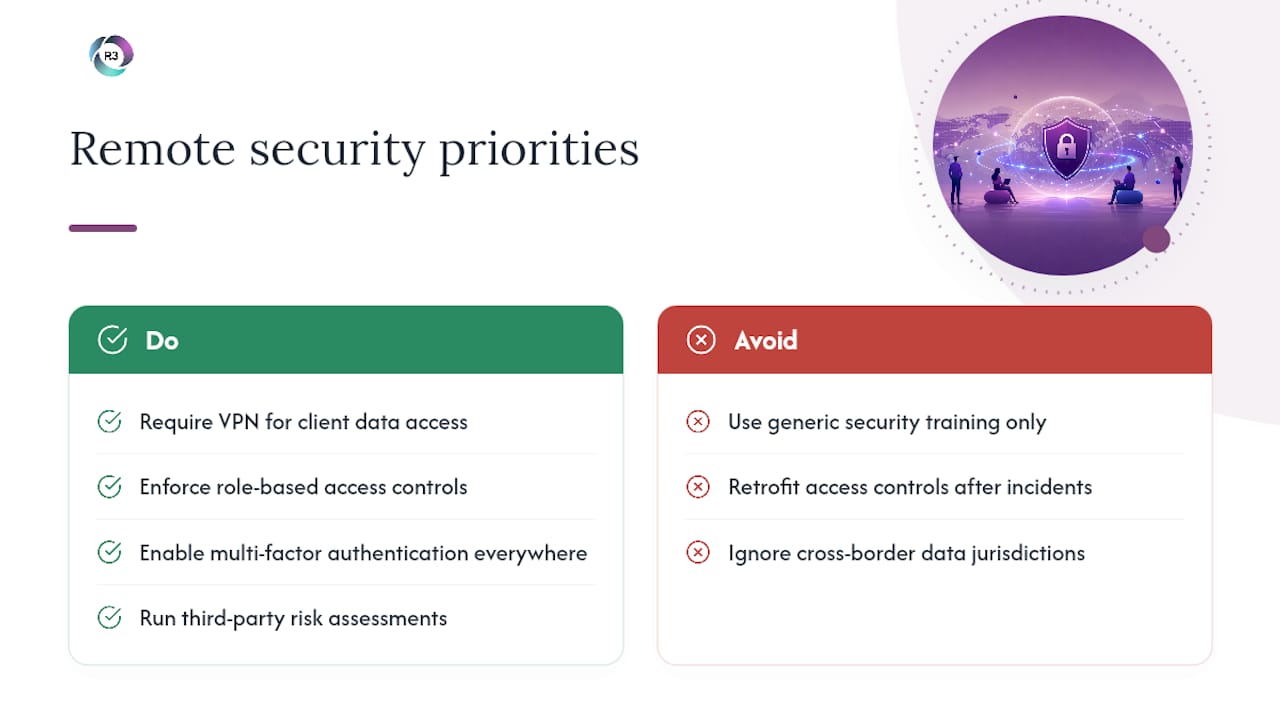
The baseline non-negotiables include mandatory VPN use for anyone accessing client data, role-based access controls so remote staff only see what their job requires, and multi-factor authentication on every system that touches sensitive information. Beyond the basics, businesses handling regulated data, healthcare records, financial information, legal documents, need remote staff trained specifically on the compliance frameworks relevant to their industry, not generic security awareness training.
Data protection gets more complicated when your remote staff work across borders. Cross-border data handling introduces jurisdictional questions about where information is stored and processed, and those questions carry real compliance weight for U.S. businesses handling customer data, making how to run a third party risk assessment a critical consideration for operational risk management. The safest approach treats every remote role as if it will eventually touch sensitive information, even if it doesn’t today, and builds access protocols accordingly from day one rather than retrofitting them after an incident forces the issue.
The Environmental Case for Remote Staffing
Remote staffing carries a sustainability upside that rarely makes it into staffing conversations, but it’s worth naming.
Fewer daily commutes across a distributed workforce reduce aggregate transportation emissions in a measurable way, even though the exact reduction depends heavily on how many employees would otherwise have driven versus used public transit. Smaller physical office footprints also cut energy consumption tied to heating, cooling, and lighting spaces that would otherwise sit half-empty. For businesses building sustainability commitments into their brand or investor reporting, a genuinely distributed remote staffing model is one of the more straightforward levers available, since it requires policy change rather than capital investment in new infrastructure.
Strategic Priorities for the Next Three Years
The businesses that get remote staffing right over the next three years will be the ones that stopped treating it as a cost-cutting tactic and started treating it as an operating design decision. Three moves matter most: audit your current roles for output clarity, pilot one dedicated hire in a recurring role before converting your whole team, and put real budget behind onboarding instead of assuming good candidates will figure it out. The trade-off you have to accept is that building this properly takes longer upfront than just posting a job and hoping. It pays back in retention you can actually measure.
— Ellis
Ready to Build a Remote Team That Actually Stays
This is an alternative to juggling a revolving freelancer roster for the roles your business depends on every week. Instead of re-onboarding a new contractor every few months, you get a fully managed, long-term dedicated remote professional matched to your business, trained, coached, and supported on an ongoing basis, not a task-doer who disappears after the invoice clears.
Whether you need administrative support, customer service, CRM management, or industry-specific roles in real estate, e-commerce, or professional services, this service handles the matching, onboarding, and oversight so you don’t have to build that infrastructure from scratch. Team members integrate directly into your existing workflows and tools, and because they are full employees with ongoing management support, you get the continuity that freelancers and task-based platforms simply can’t offer.
If a recurring role in your business has churned through multiple freelancers this year, that’s your signal to make the switch. Visit R3source to talk through which role fits best, or explore our dedicated remote professional services to see the full range of roles we support.
Sources
FAQ
Is Remote Work Dying in 2026?
No. Demand-side data shows most workers still prefer remote or hybrid arrangements, and research from the University of Birmingham found that businesses discontinuing remote work reported worse productivity outcomes than those that kept it. The model is shifting toward more structured hybrid and dedicated staffing arrangements, not disappearing.
What Jobs Will Be Gone by 2030 Due to AI?
Highly repetitive, rules-based tasks, like basic data entry or first-pass resume screening, are already being automated or heavily assisted by AI tools. Roles requiring judgment, relationship management, and context, like dedicated customer service or account management, remain far harder to automate and are exactly where businesses continue investing in dedicated remote staff.
Is Remote Work Dying Out?
No. Survey data consistently shows sustained worker preference for remote and hybrid structures, and companies that maintained remote arrangements reported significantly better productivity outcomes than those that reversed course, according to the University of Birmingham study. What’s changing is the sophistication of how companies manage it, not whether it continues.
What Did Elon Musk Say About People Working From Home?
Elon Musk has publicly criticized remote work, arguing employees should be present in offices and calling remote work arrangements ethically questionable for some roles. His position reflects one high-profile view in a broader debate; broader survey and academic data referenced throughout this guide show most businesses and workers favor continued remote or hybrid flexibility.
How Much Does It Cost to Hire a Dedicated Remote Professional Through R3source?
Pricing depends on the role, scope, and level of experience required, so current rates are available directly on the R3source website. Unlike freelance platforms billed by the task, R3source structures its services as ongoing managed staffing contracts built for long-term roles.
Recommended
Comments