

Benefits of Hiring a Virtual Assistant for Small Business


You started your business to build something meaningful. But somewhere along the way, your calendar filled up with inbox management, appointment scheduling, and data entry instead of the work that actually grows your business. The benefits of hiring a virtual assistant go far beyond convenience. They represent a real shift in how you operate, compete, and scale. This article breaks down what virtual assistants (VAs) can actually do for your business, what the numbers say about productivity and cost, and how to make delegation work from day one.
Table of Contents
Key takeaways
Point | Details |
Significant cost savings | VAs reduce staffing costs by 60 to 78% compared to full-time local employees. |
Fast productivity gains | 82% of businesses report measurable productivity improvements within the first 90 days. |
Time reclaimed daily | Delegating routine work gives you back an average of 4.4 hours per day for strategic priorities. |
Outcomes over hours | Measure VA success by response times and task throughput, not time logged. |
Onboarding determines results | Clear SOPs and documented processes reduce friction and increase long-term VA effectiveness. |
What a virtual assistant actually does
The term “virtual assistant” gets used loosely, so it helps to understand what it really means. A VA is a remote professional who handles specific business tasks on your behalf, typically working as a dedicated staff member or a contracted specialist. They are not the same as a freelancer hired for a one-time project, and they are not a replacement for in-house leadership. They sit in a distinct category: skilled, remote, and integrated into your daily operations.
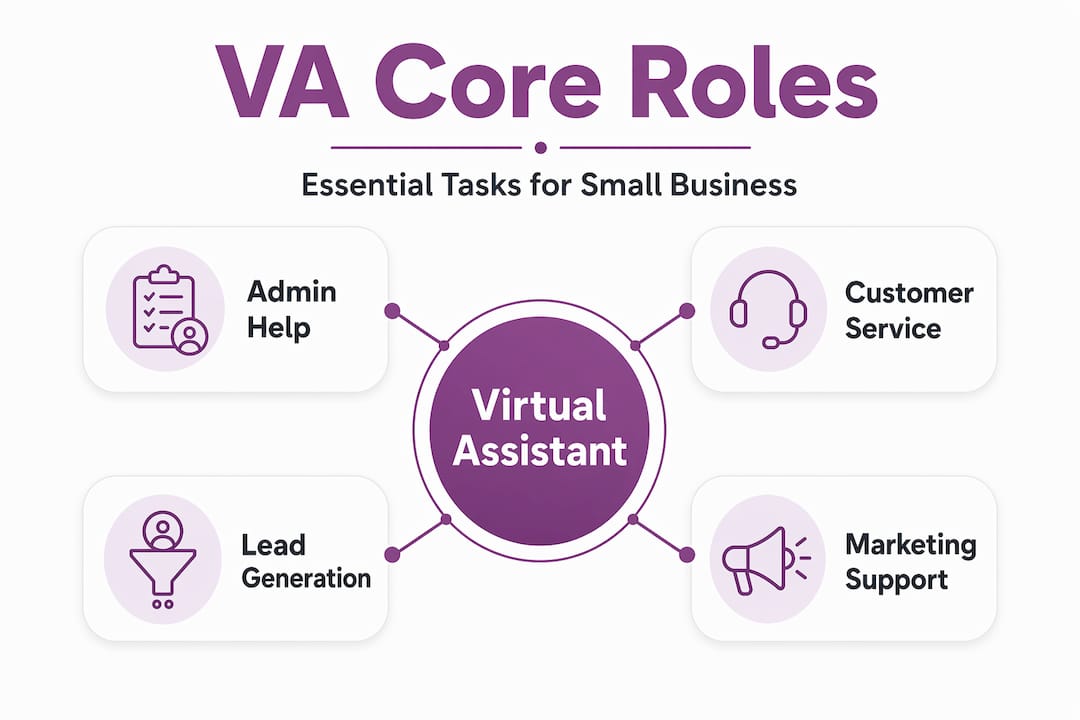
The range of tasks a VA can handle is broader than most business owners realize. Here is a practical breakdown:
Administrative support: Calendar management, email filtering, data entry, travel booking, and document preparation
Customer service: Responding to inquiries, managing support tickets, live chat, and follow-up communications
Marketing support: Social media scheduling, content research, graphic coordination, email campaign management, and SEO tasks
Sales and CRM: Lead generation, contact list management, CRM data updates, and appointment setting
Finance and operations: Basic bookkeeping, invoice tracking, vendor coordination, and reporting
Specialized roles: Some VAs focus entirely on one domain, such as Amazon store management, real estate transaction coordination, or paid ad reporting
The benefits of outsourcing these tasks come from the fact that they are real, necessary work. They just do not require your personal attention. Outsourcing non-core activities frees your internal resources for the decisions and relationships that only you can handle.
A VA fits into your workflow in one of two ways: as a dedicated team member who works set hours alongside your business, or as a task-based contractor you engage for specific deliverables. For small businesses building long-term capacity, the dedicated model tends to produce better results because the VA learns your systems, voice, and preferences over time.
The real numbers behind VA cost savings and productivity
Here is where the advantages of virtual assistants become hard to ignore. The financial case alone is compelling, but the productivity data is what changes how business owners think about growth.
Hiring a VA saves 60 to 78% compared to the true cost of a full-time local employee when you factor in salary, benefits, payroll taxes, office space, and equipment. That is not a rounding error. For a small business operating on tight margins, that difference can fund a second hire, a marketing push, or simply give you breathing room.
The productivity picture is equally strong:
82% of businesses see measurable productivity gains within the first 90 days of working with a VA
Business owners reclaim an average of 4.4 hours per day when they delegate routine tasks
Small businesses that hire VAs report an average 27% revenue increase within 12 months
Reinvesting reclaimed time into higher-value activities can yield a 40% net profit increase
Think about what 4.4 hours per day actually means. That is nearly a full extra workday every week directed toward client acquisition, product development, or strategic planning instead of inbox management.
Executives currently spend about 28% of their work week on administrative tasks that could be delegated. That is more than one full day lost every week to work that does not require executive-level judgment.
Pro Tip: Before you hire, track your own time for one week. Categorize every task as either “only I can do this” or “someone else could handle this with the right instructions.” Most business owners are shocked by how much falls into the second category.
The work-life dimension matters too. Burnout is real, and it is expensive. When you are carrying more than you ever expected, your decision-making suffers, your relationships suffer, and your business growth stalls. Delegation is not a sign of weakness. It is a prerequisite for sustainable leadership.

How to integrate a VA so you actually get results
Hiring a VA is the easy part. Getting consistent, high-quality output from that relationship requires intentional setup. Here is a process that works:
Document your tasks before you delegate them. Write out the steps for each recurring task as if you were explaining it to someone new. This forces clarity on your end and gives your VA a reliable reference point. Clear SOPs reduce onboarding friction and significantly increase long-term VA retention and effectiveness.
Start with your lowest-risk, highest-frequency tasks. Email filtering, scheduling, and data entry are good starting points. They are easy to review, easy to correct, and they free up your time immediately.
Set expectations with metrics, not hours. Measuring outcomes like response time and task throughput gives you a clearer picture of performance than tracking hours worked. Define what “done well” looks like before the work begins.
Schedule regular check-ins during the first 30 days. Weekly calls or async video updates help you catch misalignments early and build the working relationship faster.
Expand scope gradually. Once your VA demonstrates reliability in core tasks, layer in more complex responsibilities. Trust is built incrementally.
Use this comparison to decide which tasks to delegate first:
Task type | Keep in-house | Delegate to VA |
Strategic decisions | Yes | No |
Client relationship management | Yes | Partially (scheduling, follow-ups) |
Email management | No | Yes |
Social media scheduling | No | Yes |
CRM data entry | No | Yes |
Content creation (final approval) | Yes | Draft and research: VA |
Bookkeeping review | Yes | Data entry and reporting: VA |
Pro Tip: Use a VA onboarding checklist to standardize your setup process. It saves hours of back-and-forth and sets your VA up to succeed from week one.
One more factor worth considering: AI tools. GenAI is expected to transform 44% of US work time by augmenting routine knowledge work. VAs who work alongside AI tools for research, drafting, and data analysis can multiply their output significantly. The goal is not just adding a person. It is redesigning your workflow so that person and technology together produce more than either could alone.
Common myths that hold business owners back
The biggest obstacle to hiring a VA is usually not budget. It is belief. Several persistent myths keep business owners from making a move that would genuinely help them.
“I can’t trust someone I’ve never met in person.” This concern is understandable, but it conflates location with reliability. The right vetting process, clear expectations, and consistent communication create accountability regardless of geography. Outsourcing customer service and operations to remote professionals is standard practice for companies of every size because it works when managed well.
“It will take too long to train someone.” The upfront investment in training is real, but it is one-time. Once your VA understands your systems, they operate independently. The hours you spend onboarding are recovered within weeks.
“Virtual assistants are only for big companies.” This is the most damaging myth of all. A virtual assistant for small business is not a luxury. It is often the most practical way to scale without the overhead of a full-time hire. Outsourcing scalability means you can expand or adjust support as your business needs change, without the commitment of a permanent payroll addition.
The challenges that do exist are manageable:
Communication gaps are solved with clear async tools and regular check-ins
Quality concerns are addressed by working with vetted professionals and reviewing output in the first few weeks
Retention improves dramatically when VAs are treated as team members, given growth opportunities, and paid fairly
The business owners who struggle with VAs are almost always the ones who hired without a clear plan. The ones who thrive treated the hire like any other strategic investment: with preparation, clear goals, and patience during the ramp-up period.
My honest take on what delegation really changes
I’ve watched a lot of business owners make the same mistake I almost made. They wait until they’re completely overwhelmed before they consider getting help. By that point, they’re too burned out to onboard someone well, and the experience confirms their fear that delegation doesn’t work.
What I’ve learned is that the real transformation from hiring a VA isn’t about the tasks. It’s about identity. When you stop being the person who does everything, you start being the person who leads everything. That shift changes how you think about your business, your time, and what’s actually possible.
In my experience, the owners who see the biggest gains aren’t the ones who delegate the most tasks. They’re the ones who delegate the right tasks with clear documentation and then actually use the time they get back for strategic work. The VA doesn’t grow your business. You do. But you can only do that if you’re not buried in your inbox.
I’ve also seen that the first virtual assistant hire is almost always the hardest one. After that, business owners wonder why they waited so long. The clarity you gain about your own role, your systems, and your capacity for growth is worth as much as the time savings.
— Ellis
Build your support system with R3source
R3source helps small businesses and entrepreneurs hire dedicated remote professionals from the Philippines who integrate directly into your operations. These are not task-based freelancers. They are trained, long-term team members who learn your systems, represent your brand, and handle the daily work that keeps your business running.
Whether you need administrative support, customer service, lead generation, CRM management, or marketing help, R3source matches you with the right professional and supports the onboarding process so you get results faster. Clients across real estate, e-commerce, and service businesses have seen real growth after building their remote team with R3source. Read what they have to say on the client reviews page. If you are ready to reclaim your time and build the team you need to grow, R3source is the place to start.
FAQ
What are the main benefits of hiring a virtual assistant?
The primary benefits include cost savings of 60 to 78% compared to full-time local hires, measurable productivity gains within 90 days, and an average of 4.4 hours per day reclaimed for strategic work.
How much does a virtual assistant cost compared to a full-time employee?
VAs typically cost 60 to 78% less than full-time local employees when you account for salary, benefits, taxes, and overhead. The exact rate varies by skill level and location.
What tasks can a virtual assistant handle for a small business?
VAs can manage email, scheduling, customer service, social media, CRM updates, lead generation, bookkeeping support, and more. The best starting point is any recurring task that does not require your direct judgment.
How long does it take to see results from a virtual assistant?
Most businesses see measurable productivity improvements within the first 90 days. Results come faster when you invest in clear onboarding documentation and defined performance metrics from the start.
Is hiring a virtual assistant worth it for a small business?
Yes. Small businesses that hire VAs report an average 27% revenue increase within 12 months, largely because owners redirect their time toward revenue-generating activities instead of administrative work.
Recommended
Comments