

Role of Virtual Assistants in Founder Workflows


Most founders don’t have a time problem. They have a delegation problem. The role of virtual assistants in founder workflows goes far beyond answering emails or booking flights. When used strategically, a well-integrated VA can give you back 10 or more hours every week, reduce decision fatigue, and free your attention for the work that actually builds your business. This article walks you through what VAs can realistically handle, how to structure their work for consistent results, and how to decide which tasks are worth delegating versus automating.
Table of Contents
Key takeaways
Point | Details |
VAs do more than admin | Virtual assistants handle marketing, CRM updates, customer outreach, and AI-assisted workflows beyond basic tasks. |
Structure drives results | Daily task limits of 3 to 5 priorities plus weekly check-ins keep VA output predictable and high quality. |
Sequence before delegating | Eliminate a task first, then automate it, then delegate. Skipping this order creates unnecessary overhead. |
AI VAs multiply time savings | Using AI-powered assistants with a “draft, do not approve” model can cut founder admin time by over 60%. |
Onboarding determines long-term success | Clear SOPs, defined communication protocols, and early feedback loops prevent most common VA failure modes. |
What virtual assistants really do in founder workflows
The common picture of a virtual assistant is someone who manages a calendar and sends a few emails. That picture is incomplete. The actual scope of tasks for virtual assistants in a modern founder workflow covers at least five functional areas.
Administrative support is the foundation. This includes inbox triage, scheduling, travel coordination, data entry, and document management. These tasks are time-consuming and cognitively draining, but they require almost no strategic judgment. That makes them perfect for delegation.
Marketing and content operations are where many founders underestimate their VAs. A skilled VA can update your website, schedule social media posts, manage your content calendar, and handle customer outreach sequences. They may not write your founding vision statement, but they can absolutely maintain the engine that distributes it.

CRM and pipeline management is another high-ROI category. Email triage, follow-up tracking, and CRM updates directly reduce the mental clutter that builds up when leads fall through the cracks. A VA who owns your CRM hygiene keeps your revenue operations from quietly deteriorating.
Customer service rounds out the picture. Response management, FAQ handling, and first-contact resolution can all sit with a VA, leaving you to handle escalations only.
Inbox triage and email drafting
Calendar management and scheduling
Social media scheduling and content updates
CRM data entry and pipeline tracking
Customer service first-response handling
Travel booking and expense tracking
Research and report compilation
Pro Tip: When you first start working with a VA, map out every recurring task you do in a week and mark the ones that require your unique judgment. Everything else is a delegation candidate.
How to structure VA work for consistent output
Structure is where most founder-VA relationships succeed or fail. Without it, your VA spends time waiting for direction and you spend time answering questions you never anticipated. Structuring VA work into daily execution plus weekly planning prevents both problems.
Here is a practical rhythm that works across industries:
Daily priorities: Limit your VA to 3 to 5 clearly defined tasks per day. More than that dilutes focus and increases the chance of errors. Each task should have a clear deliverable and a deadline.
Weekly alignment meeting: Block 30 to 60 minutes once a week to review what was completed, identify blockers, and set priorities for the week ahead. This meeting should follow an agenda your VA prepares in advance.
Weekly status report: Your VA submits a short written summary of completed tasks, current status, and anything that needs your input. This eliminates the need for constant check-ins throughout the week.
Monthly review: Once a month, evaluate performance against defined goals, discuss any shifts in your business priorities, and assess whether the VA has capacity for additional responsibilities.
Rhythm | Format | Time investment |
Daily task list | Written priorities with deadlines | 10 minutes to review |
Weekly alignment | Video or voice call with agenda | 30 to 60 minutes |
Weekly report | Written summary from VA | 10 minutes to review |
Monthly review | Structured performance conversation | 45 to 60 minutes |
This structure does something important: it gives your VA the context they need to make good decisions without interrupting you every hour. Defined daily, weekly, and monthly routines improve reliability and founder satisfaction in measurable ways.
Pro Tip: Have your VA own the agenda for every weekly meeting. If they can’t articulate what they worked on and what they need, that’s important information about how the role is structured.
Integrating AI-powered assistants into your workflow
AI-powered VAs represent a meaningful shift in what’s possible for founder productivity tips. The numbers are hard to ignore. After deploying an AI assistant, one startup CEO dropped from 14.5 hours per week on admin down to 4.3 hours. Median email response time fell from 4 hours to 45 minutes. Scheduling conflicts dropped by 82%.
The mechanism behind those gains is worth understanding. AI assistants categorize and prioritize emails, draft responses, flag meeting requests, and prepare briefing documents. They don’t send anything without approval. That distinction matters.
“The ‘draft, do not send’ principle is what makes AI VA integration safe for founders. The AI handles volume, you handle judgment.” — AI Executive Assistant case study, Agentmelt
The batch approval model is how this works in practice. Instead of reviewing and approving each draft in real time, the CEO in that case study reviewed drafts twice daily. The result was an 82% acceptance rate. That means the AI was producing usable output the vast majority of the time, with the founder investing minimal attention.
Claude for Small Business extends this further with 15 integrated workflows covering finance, sales, marketing, and HR. These connect directly to tools like QuickBooks, HubSpot, Canva, and Google Workspace, allowing end-to-end workflows covering finance and operations without switching platforms.
Key benefits of AI-powered VA integration:
Email categorization and draft responses prepared for founder approval
Meeting scheduling with context-aware prioritization
CRM updates and follow-up reminders triggered by conversation summaries
Invoice chasing and financial reporting summaries through accounting tool integrations
Social media and marketing content drafts queued for review
The key risk to manage is over-automation before you’ve validated the workflow. Start with one or two processes, verify accuracy over two to three weeks, then expand.
Deciding what to delegate, automate, or keep
This is where most founders leave money on the table. They delegate tasks without first asking whether those tasks should exist at all.
The right sequence is this: eliminate first, then automate, then delegate. Delegation is outsourcing a task, but automation removes the underlying work entirely. If you’re spending VA hours on a weekly report nobody reads, you’ve added cost without solving the real problem.
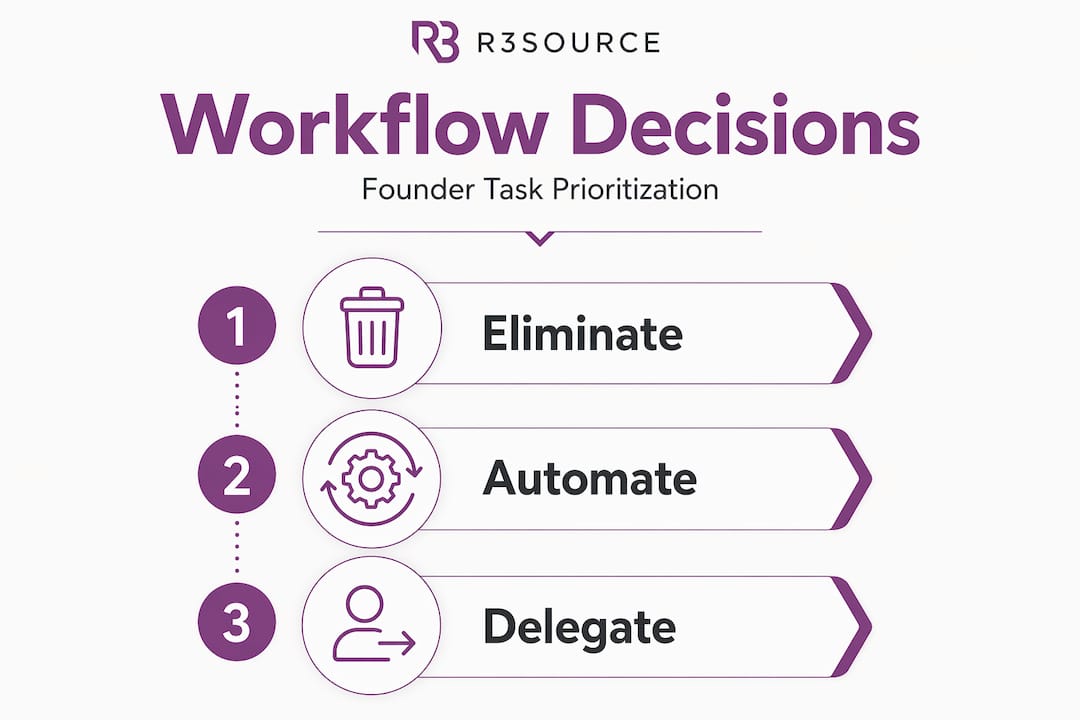
Once you’ve eliminated the unnecessary, apply this ROI framing. If your time is worth $168 per hour as a founder, five hours saved monthly through automation or delegation yields roughly $840 in recovered value against a $40 tool cost. That’s a 21x return. Most founders never calculate this, which is why they stay stuck doing work that doesn’t belong to them.
A practical audit heuristic: any repeatable task taking more than two hours per month should be evaluated for automation or delegation. Apply it to your last 30 days.
High-value delegation targets: inbox management, scheduling, travel logistics, CRM updates, customer follow-ups
High-value automation targets: invoice generation, recurring reports, social media scheduling, data exports
Tasks founders should keep: strategic decisions, investor and key client relationships, hiring judgment, vision and positioning
Watch for two common traps. The first is overloading your VA with vague tasks. “Handle customer emails” is not a task. “Respond to all customer emails using the attached templates and flag anything outside those categories for my review” is a task. The second trap is delegating before documenting. If you can’t describe the process in writing, your VA can’t execute it reliably. Explore delegation examples for entrepreneurs to see how other founders have structured this in practice.
Building a VA relationship that actually lasts
The quality of your VA relationship is determined in the first two weeks. That’s when expectations are set, communication patterns are established, and misalignments surface. Most VA failures are onboarding failures.
Effective virtual assistants function as force multipliers when treated as team members with context, not just task takers. That means sharing the “why” behind requests, providing examples of good work, and giving feedback quickly and specifically.
Here’s what a strong onboarding structure looks like:
Write a standard operating procedure for every recurring task before handing it off
Define your preferred communication channel and expected response times upfront
Share examples of past work you consider high quality so your VA has a reference point
Set a 30-day review checkpoint to identify what’s working and what needs adjustment
Create a shared task management space, whether that’s Asana, Trello, ClickUp, or a simple shared doc
Without structure, confusion and inconsistent output will cause frustration for both sides. The good news is that a well-documented process scales. Once your VA is running smoothly, you can add scope, add team members, or replicate the model across business functions. Read more about finding a reliable long-term VA to get the hiring side right from the start.
My honest take on working with virtual assistants
I’ll be direct with you. The founders I’ve seen get the most out of virtual assistants are not the ones who hire the most experienced VA. They’re the ones who show up as the best delegator.
In my experience, the biggest mistake is treating a VA like a safety net you throw tasks at when you’re overwhelmed. That produces inconsistent results and leads founders to conclude that “VAs don’t work for me.” The real issue was never the VA. It was the absence of structure, context, and documentation.
What I’ve learned is that the “draft, do not send” model isn’t just about AI. It’s a philosophy. Give your VA a clear outcome, let them take the first pass, and review with intention. That workflow preserves your voice, catches errors early, and builds trust over time. It also trains you to let go, which is the hardest part for most founders.
On AI integration: I think founders who are skeptical about delegating to AI are asking the right question. Blind automation creates silent errors. But human-in-the-loop approval at the batch level, not the task level, is a workable middle ground. You stay in control without staying in the weeds.
The founders who struggle with VAs share one trait. They hold on to tasks they should release because releasing them feels like losing control. In reality, releasing the right tasks is the only way to gain the kind of control that actually matters.
— Ellis
Ready to put this into practice with R3source?
If you’ve read this far and you’re thinking about where to start, the answer is probably simpler than you think. You don’t need a perfect system before you hire. You need one well-defined role and a reliable person to fill it.
R3source connects founders with dedicated virtual assistants from the Philippines who are trained to integrate directly into your existing operations. From administrative support to CRM management and customer service, R3source provides the kind of long-term, accountable partnership that produces real results, not just task completion. Whether you’re ready to outsource your virtual assistant needs today or want to explore what a remote team could look like for your business, R3source is built to help you scale without the overhead.
FAQ
What is the role of virtual assistants in founder workflows?
Virtual assistants handle time-consuming operational tasks such as inbox management, scheduling, CRM updates, and customer outreach, freeing founders to focus on strategic priorities. When integrated with structured workflows and clear documentation, they function as a reliable extension of the founding team.
How many hours can a VA realistically save per week?
AI-assisted VAs have helped founders reduce admin time from over 14 hours per week to under 5, depending on the scope of tasks delegated. Human VAs managing recurring operations typically save founders 5 to 15 hours per week.
What tasks should founders delegate to a virtual assistant first?
Start with the highest-volume, lowest-judgment tasks: inbox triage, calendar management, CRM data entry, and customer follow-ups. These offer immediate time returns and are easy to document with standard operating procedures.
How do I know if I should automate or delegate a task?
Apply the eliminate-automate-delegate sequence. If a task is fully rules-based and repeatable, automate it. If it requires human judgment or relationship context, delegate it to a VA. Any repeatable task taking over two hours monthly is worth auditing under this framework.
How do virtual assistants help with AI tool integration?
VAs can operate AI tools on your behalf, managing drafts, reviewing outputs, and submitting approvals within platforms like QuickBooks, HubSpot, and Google Workspace. This human-in-the-loop model keeps automation safe while dramatically reducing your direct time investment.
Recommended
Comments