

Remote Staffing Solutions for Business Owners in 2026

Remote staffing solutions are workforce strategies that let companies hire and manage skilled professionals outside a traditional office, using legal models like Employer of Record (EOR) and Contractor of Record (CoR) to handle payroll, compliance, and contracts without setting up a local entity. For business owners trying to grow without multiplying overhead, this approach changes what’s possible. You can build a capable, dedicated team in days rather than months, reduce fixed costs, and stay legally protected across jurisdictions. Platforms like Remote.com and Remire have made this faster than ever, and providers like R3source have made it accessible to small and mid-sized businesses that don’t have an in-house legal team.
What are the main types of remote staffing solutions?
The three primary models are Employer of Record, Contractor of Record, and direct entity hiring. Each carries different cost structures, compliance obligations, and risk profiles. Choosing the wrong one is one of the most common and expensive mistakes growing businesses make.
An EOR acts as the legal employer for your remote hire, managing employment contracts, payroll, tax deductions, statutory contributions, and benefits on your behalf. You direct the work; the EOR handles everything else. This model is ideal when you want to hire someone in a country or state where you have no legal entity, and when the role is ongoing, full-time, and employee-like in nature.

A Contractor of Record keeps the worker classified as an independent contractor while managing compliant contracting and payment flows. EOR eliminates misclassification risk entirely; CoR reduces it but does not eliminate it. CoR works best for project-based or short-term engagements where the worker genuinely operates independently.
Model | Classification | Compliance burden | Best use case |
Employer of Record | Employee | Fully managed by EOR | Long-term, full-time remote roles |
Contractor of Record | Independent contractor | Partially managed | Project-based or short-term work |
Direct entity hiring | Employee | Managed internally | High-volume hiring in one jurisdiction |
Pro Tip: Before selecting a model, map the actual working relationship. If your remote hire works set hours, uses your tools, and reports to your managers daily, that is an employee-like arrangement. Forcing it into a CoR structure creates misclassification exposure that can result in back taxes and penalties.
Worker classification depends on the real nature of the working relationship, not the title on the contract. A worker who operates like an employee but is labeled a contractor is a liability, regardless of what the agreement says.
What are the onboarding layers for remote hires in 2026?
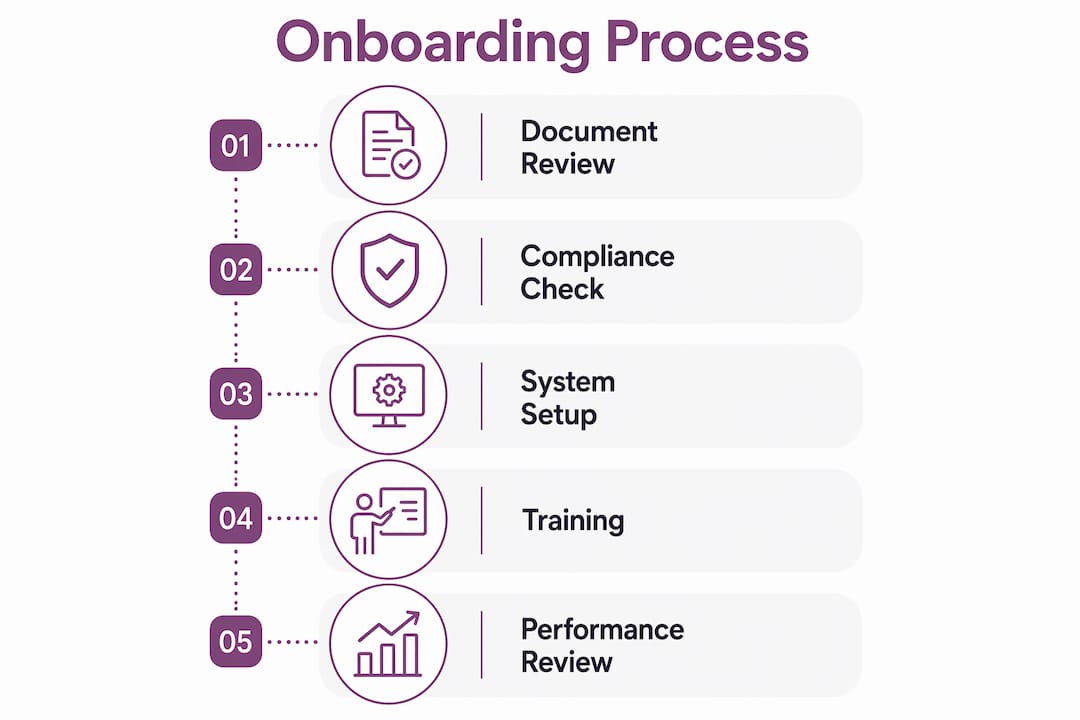
Remote employee onboarding involves three distinct layers, and most businesses underestimate how long the first one takes. Understanding the sequence prevents payroll delays and compliance gaps before they happen.
Compliance onboarding covers employment contracts, tax registration, work authorization verification, and right-to-work checks. This is the longest layer and the highest-risk. Onboarding completes in roughly two weeks with an EOR provider, compared to six to sixteen weeks when setting up a direct legal entity. That gap represents real lost productivity and delayed revenue.
Payroll onboarding includes collecting bank details, setting up payroll runs, and configuring tax withholding. Payments cannot start until compliance artifacts are complete and verified. Skipping steps here creates errors that are difficult to reverse and can damage trust with a new hire on day one.
Operational onboarding covers equipment provisioning, system access, tool introductions, and team integration. This layer is the most visible to the new hire and the most directly tied to early productivity. It should begin in parallel with payroll setup, not after it.
The compliance layer is where most delays originate. Many teams treat it as an administrative formality rather than a project with real dependencies and deadlines. Documenting onboarding steps formally with timing gates, such as contract signed, right-to-work verified, and bank details collected, prevents the cascading delays that push a two-week onboarding into a six-week one.
Pro Tip: Build a remote onboarding checklist with hard timing gates. Each gate should be a document or verification milestone that must be completed before the next phase begins. This is not bureaucracy. It is the difference between a hire who is productive in week two and one who is still waiting on system access in week four.
What compliance considerations matter most in remote staffing?
Compliance in remote staffing is jurisdiction-driven. Employment law applies where the work is performed, not where your business is headquartered. A remote hire working from the Philippines, Texas, or Ontario is subject to the labor laws of that location, regardless of where your company is registered.
This principle has direct consequences for how you structure every hire:
Tax obligations vary by location. An EOR manages local payroll tax registration and remittance, removing this burden from your team entirely.
Benefits requirements differ by jurisdiction. Statutory contributions, paid leave entitlements, and social insurance obligations are all location-specific.
Contractor tax forms require careful management. For U.S.-based engagements, collecting the correct IRS forms, whether W-9 for domestic contractors or W-8BEN for international ones, is required to avoid withholding mistakes and missed filings.
Misclassification risk is real and costly. The IRS and equivalent agencies in other countries look at actual working arrangements, not contract language, when auditing classification.
“Compliant remote hiring starts with focusing on where the employee physically works, not business HQ location. This single principle drives every staffing model decision that follows.” — Teamed, 2026 Mid-Market Hiring Guide
Security compliance adds another layer that most businesses overlook until it becomes a problem. The most challenging gap in remote security programs is lifecycle execution, specifically the speed and reliability of deprovisioning access when a team member leaves or changes roles. A process-driven joiner-mover-leaver framework is not optional for businesses handling sensitive client data. It is a baseline requirement for SOC 2 alignment and general data hygiene.
How do remote staffing solutions reduce overhead and support scaling?
The financial case for remote staffing is direct. You eliminate office space costs, reduce equipment overhead, and avoid the legal and administrative expenses of setting up entities in new jurisdictions. The operational case is equally strong. Speed matters when you are growing.
Using an EOR provider, your first hire can be onboarded in as little as 48 hours with no entity setup, no lawyers, and no compliance preparation on your side. Compare that to the six to sixteen weeks required to establish a direct legal presence in a new location. For a business trying to respond to a growth opportunity, that difference is the gap between capturing a market and missing it.
The benefits of remote staffing compound as your team grows:
No incremental office costs per hire
Access to skilled professionals in lower-cost labor markets without sacrificing quality
Ability to scale up or down based on actual business needs, not fixed headcount commitments
Reduced benefits administration burden when working through an EOR or a provider like R3source
Virtual employee services and remote workforce management tools have matured significantly. Platforms now handle scheduling, performance tracking, communication, and compliance monitoring in integrated systems that reduce the management overhead of distributed teams. The argument that remote teams are harder to manage than in-office teams no longer holds up against the evidence.
R3source, for example, provides dedicated remote professionals from the Philippines who integrate directly into your operations. This is not a freelance marketplace model. These are long-term team members trained to handle administrative support, customer service, CRM management, and lead generation, freeing you to focus on revenue-generating work.
How to select and manage remote staffing solutions effectively
Choosing the right provider and model requires a structured evaluation, not a quick comparison of pricing pages. Here is a practical framework for making the decision well.
Define the role type first. Is this an ongoing, employee-like position or a project-based engagement? The answer determines whether EOR or CoR is appropriate before you evaluate any provider.
Assess compliance coverage. Does the provider cover the jurisdictions where your hires will work? Gaps in coverage create the exact legal exposure you are trying to avoid. Providers like Remote.com and Remire publish their country coverage lists publicly.
Evaluate onboarding speed. Ask specifically how long compliance onboarding takes for your target location. A provider who cannot give you a specific timeline is a provider who has not solved this problem.
Check local expertise. Payroll rules, statutory benefits, and termination requirements vary significantly by country. A provider with genuine local expertise, not just a local partner network, reduces your risk substantially.
Plan for the transition. If you expect to hire more than ten to fifteen people in a single jurisdiction, model the cost of transitioning from EOR to a direct entity. At scale, the EOR fee structure may exceed the cost of establishing your own legal presence.
Build security and access management into onboarding from day one. Define who provisions access, what systems are included, and how access is revoked when someone leaves. This process should be documented before the first hire, not created reactively after a problem occurs.
Pro Tip: When evaluating outsourced staffing options, ask each provider for a sample onboarding checklist and a real client timeline from a comparable jurisdiction. Providers who have solved compliance onboarding have documentation to show for it. Those who haven’t will give you vague answers.
For hiring offshore employees, the legal and compliance requirements are more complex than domestic hiring, but the cost and talent access advantages are proportionally larger. The key is pairing the right provider with a clear internal process for managing the relationship once the hire is onboarded.
Key takeaways
Selecting the right remote staffing model, whether EOR, CoR, or direct hiring, determines your compliance exposure, onboarding speed, and total cost of building a remote team.
Point | Details |
Model selection drives compliance risk | Match EOR to employee-like roles and CoR to genuinely independent contractors to avoid misclassification penalties. |
Compliance onboarding is the critical path | With an EOR, onboarding takes roughly two weeks; direct entity setup takes six to sixteen weeks. |
Jurisdiction determines employment law | Employment law applies where the work is performed, not where your business is registered. |
EOR accelerates first hires significantly | Providers like Remire can onboard a first hire in 48 hours, removing entity setup entirely. |
Access lifecycle management is non-negotiable | Build a joiner-mover-leaver process before your first hire to protect data and maintain compliance. |
What I’ve learned watching businesses get remote staffing wrong
Most of the costly mistakes I see in remote staffing come from one source: treating compliance as a back-office detail rather than the foundation of the entire hiring process. Teams get excited about the talent they are about to bring on, rush through the legal layer, and then spend weeks untangling payroll errors or misclassification exposure that could have been avoided with two extra days of preparation.
The businesses that scale well with remote teams do the opposite. They treat compliance onboarding as a first-class project with an owner, a checklist, and hard deadlines. They choose their employment model based on the actual nature of the work, not on which option is cheaper or faster to set up. And they build access and security management into their onboarding process from the start, not as an afterthought.
The other pattern I consistently observe is underestimating how much the right provider matters. An EOR or managed staffing provider with genuine local expertise is not interchangeable with one that operates through a thin partner network. The difference shows up in the details: how quickly they resolve a payroll discrepancy, how accurately they handle a statutory leave entitlement, how clearly they communicate a regulatory change. These are not edge cases. They are the day-to-day reality of managing a distributed team.
Remote staffing, done well, gives you access to talent and operational capacity that would otherwise require significant capital investment. Done poorly, it creates legal and operational problems that cost more to fix than they would have cost to prevent.
— Ellis
Build your remote team with R3source
R3source helps business owners build dedicated remote teams without the compliance complexity, overhead costs, or hiring delays that slow most companies down. Every remote professional R3source places is trained to integrate directly into your operations, handling the daily work that keeps your business running so you can focus on growth.
Whether you need administrative support, customer service, CRM management, or lead generation, R3source provides long-term remote professionals from the Philippines who deliver consistent, accountable performance. This is not a freelance platform. It is a dedicated remote staffing model built for business owners who want real team members, not task-based contractors. Explore R3source’s remote staffing solutions and find out how quickly you can build the support system your business needs.
FAQ
What is an Employer of Record in remote staffing?
An Employer of Record is a third-party provider that legally employs your remote hire, managing payroll, taxes, benefits, and compliance on your behalf. Platforms like Remote.com handle this end-to-end with no legal entity setup required on your side.
How long does remote employee onboarding take?
With an EOR provider, onboarding typically completes in about two weeks. Setting up a direct legal entity in a new jurisdiction takes six to sixteen weeks, making EOR the faster path for most growing businesses.
What is the difference between EOR and CoR?
EOR converts a worker to a full employee with statutory benefits and eliminates misclassification risk. CoR keeps the worker as an independent contractor with compliant payment management but does not fully eliminate classification risk.
How do I know which remote staffing model is right for my business?
Start with the nature of the role. If the worker will operate like an employee, with set hours, your tools, and direct management, use an EOR. If the engagement is project-based and the worker operates independently, a CoR or direct contractor arrangement may be appropriate.
Does employment law follow the worker’s location or my company’s location?
Employment law applies where the work is performed, not where your business is headquartered. This jurisdiction-first principle means every remote hire requires compliance with the labor laws of the worker’s physical location.
Recommended
Comments